What you’re going through has meaning.
We uncover it together.
My method
I don’t work from a script. I don’t have a fixed protocol. But I do have an approach — precise, and embodied. I always start with the body: the sensations, the tension, the places that tighten when you talk about what you’re going through. It’s often the body that shows the way, before the words do.
IFS, my main framework
My main framework is IFS — Internal Family Systems. The starting idea is simple: we are all made of several parts. One part of you wants to move forward, another is afraid; one part would like to speak, another would rather stay quiet so as not to be a bother. That’s normal — these parts formed over the course of our experiences, usually to protect us from pain.
The trouble is that sometimes they contradict each other, or stay locked into a role they took on a long time ago. We end up feeling stuck, pulled in two directions, without always knowing why.
The good news is that these parts aren’t fixed. By going to meet them — listening to them, understanding what they carry and what they were trying to protect — we can relieve them of their burdens. They find their right place again, and you find your balance and a quieter space inside.
The body and old wounds
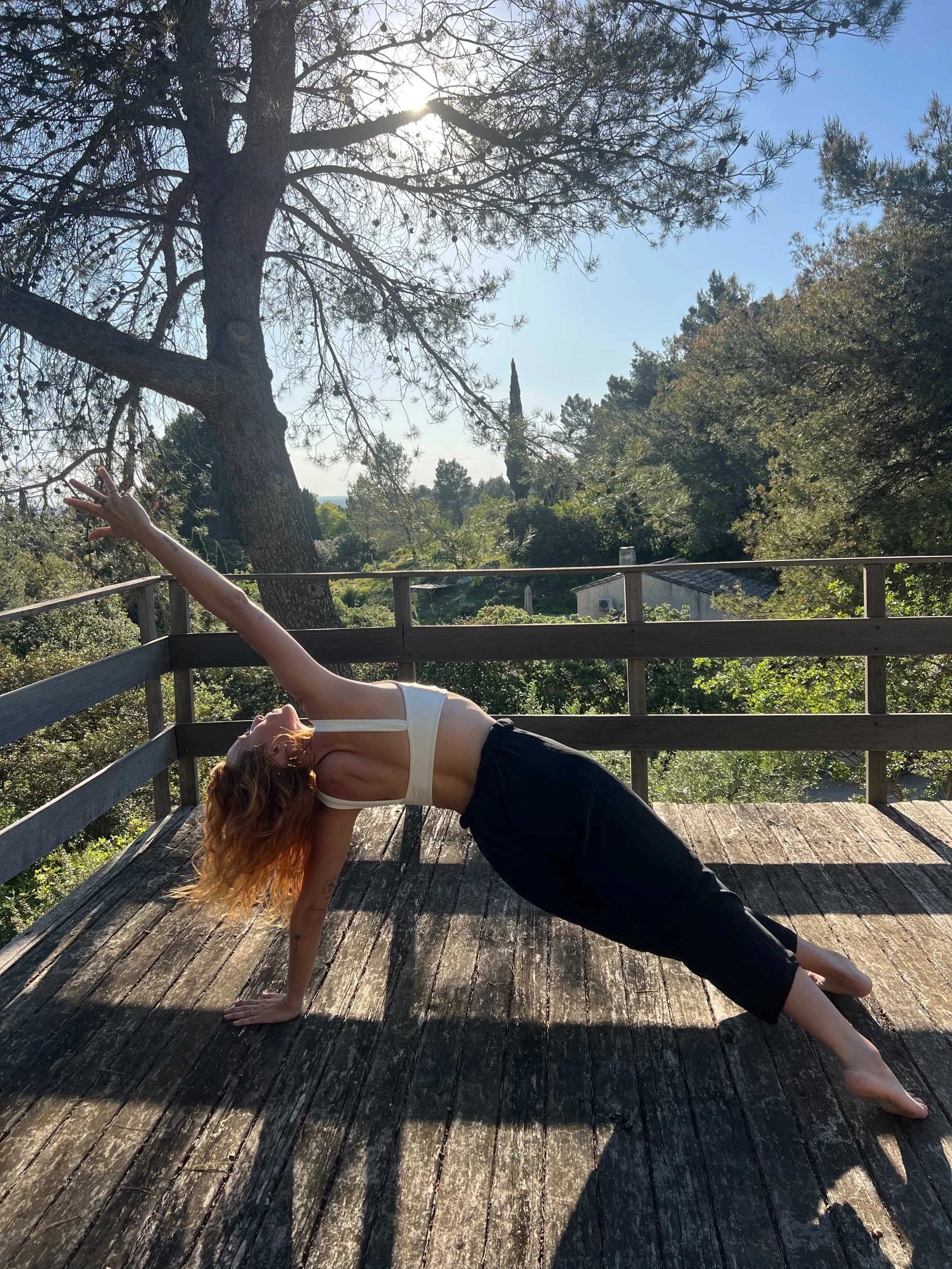
Alongside IFS, I work directly with the body. Through somatic work and guided meditations, we make contact with the places where old wounds — sometimes from childhood — have stayed written in, so they can be met and soothed. The body keeps the memory of what we have lived; it is also through the body that we repair.
Mindfulness and breath
They run underneath all of this work: they help you stay present, regulate yourself, come back to yourself when it’s too much. They are simple tools, and you can take them with you, well beyond our sessions.
We don’t heal alone
We are built in relationship. We heal in relationship.
When we are very small, we are built in the gaze of others — our parents, school, society. That gaze shapes us, and sometimes it is also where we get hurt.
That’s why nothing really comes undone on our own, inside our own head. Pain kept to yourself stays frozen; seen, said, received by someone else’s gaze, it starts moving again. As long as it stays unspoken, shame keeps us locked in — named in front of a kind witness, it loses its grip. Grief carried alone crushes us — shared, it becomes a path we can walk through.
We find that connection in the circle, and also one to one: the moment words are set free, something is already coming undone. That is where healing begins.
What it’s for
The point is never to “fix” something from the outside, or to make what you’re going through disappear. It is to go to the root, for a relief that lasts — and so you feel connected again, whole, yourself.
If something in this resonates, we can start by talking about it.
“Her expertise and the souls she gathered created a sacred space of connection and healing.”
— Michelle
Frequently asked questions
How is your approach different from more traditional therapy?
I am a therapist, so what I offer is a form of therapy — but it isn’t limited to talking alone. I bring in IFS, somatic work and mindfulness to reach what is happening in the body, not only in the words. It is embodied therapy, and it enriches a more traditional approach.
Is this for me?
If you are going through a transition — a loss, a breakup, a change of direction — and you sense there is something deeper to explore, then yes. You don’t need to be doing well to start. You just need to want to understand.
What does it actually look like?
It depends on the format you choose: one-to-one sessions, online support groups, or in-person workshops. In all three, the ground is the same: safety, presence, and the possibility of finally feeling seen, heard, and part of something. Because the heaviest emotions, like shame, only really dissolve when they are received by someone else’s gaze. One to one or within a group, each format is built to give you a space where you can set down what you carry, at your own pace.